Category Archives: Wild Foraging

Montana Standard Guest opinion: Montana ‘shrooms

This is a guest opinion written in response to an earlier piece on Paul Stamets.  

http://www.mtstandard.com/articles/2009/05/15/opinion/hjjajeifhgfgif.txt

Guest opinion: Montana ‘shrooms

By Dean Robbins – 05/14/2009

Ever since The Standard published a Monday Musings column on how great mushrooms are (March 16), I’ve been wanting to add my two cents.

The importance of mushrooms in Montana can be summed up in one word: food! In a state famous for extreme weather and difficult growing conditions, we need mushrooms to produce food in short growing seasons and to lay dormant during dry spells. Mushrooms provide food for soil as a fungus that feeds plants in short, harsh growing seasons and food for people and animals living under the same adverse conditions. Our forests need them for both plants and animals.

Farming in Montana has the most to gain from mushrooms, because of unpredictable weather and marginal soil in most places. Add to this a tough economy and rising operating costs and farmers have it difficult in Montana. Mushrooms can help with extra income as well as food for the family.

They are also very adept at growing on waste and can turn waste into produce. Fungus is very useful at stabilizing, nourishing and helping to optimize the soil, allowing a farmer to produce more from less acreage. Mushrooms are also efficient, producing one pound of fresh mushrooms from every pound of dry wheat straw .They can be a great, cheap domestic food to sell or eat. All of this could help family farms financially and help make waste productive, while reducing run-off.

The forests in Montana have shallow soil and wash very easily. Along with minimal rainfall, insects and short growing seasons, our forests have a rough time recovering from natural disasters and harvesting. Our pristine waters, feeding blue ribbon trout streams as well as our drinking water, need plants to stay clean. Mushrooms, or the fungus that feeds them, stabilize soil, minimizing run-off and helping plants get a foot hold.

The importance of fungus for trees became obvious when growers took bare root pine trees to South America and they all died. It was discovered that the natural fungus these trees need to survive was missing there, and it must be present for them to live.

Mushrooms also thrive on stumps and could become a secondary income from logging operations or beetle kill stumps. Bears eat snowbank mushrooms right out of hibernation, and they are an important source of protein for them when little else is around. Deer and many forest animals also eat mushrooms.

And yes, we lowly humans also love mushrooms. They are an important part of my diet. I learned to hunt mushrooms at the knee of my grandfather, just as my grand- children learn about mushrooms with me. It is a family affair, and we love to gather a safe, wild meal. Traditions that are natural and seasonal are good for the family and important to children. In a time when most everything our youth sees is electronic and commercial, this is an activity that can bring them closer to nature.

I also think it is important to teach our youth survival and how to be self sufficient. Mushrooms can help us with that, too!

— Dean Robbins lives in Bozeman and has long been fascinated with mushrooms. Contact him via e-mail at montanamushrooms@gmail.com and visit his Web site at www.MontanaMushrooms.com.
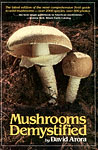
Book Review, Mushrooms Demystified

“Mushrooms Demystified”, by David Arora is one of the best identification books for this area.

mushrooms-demystified This book has a thorough description of mushroom terms, features and families. There is even a section on Greek and Latin terms to make the scientific names more understandable. The bible of mushroom books, as it is known, is my most complete identification guide.Paired with Davids companion book, “All the Rain Promises and More” is a powerful tool for learning fungus.
There is a general key in the beginning, to get you in the right family, and then each section has a detailed key that is very straight forward and easy to use.Edibility is covered as well as toxicity and naming history.There is black and white photos throughout the book  and colored plates in the center that are outstanding!There is a section on mushroom toxins with details on the chemicals involved.Symptoms, emergency advice and examples of poisonings are included.

“Mushrooms Demystified” is a great Identification Guide and good way to get an overall understanding of the great world of FUNGUS! Even though it is centered around his home in California it is very effective here in the NorthWest. Go get your copy today…at your local bookstore. Here in Bozeman we are lucky to have Vargo’s on main street.

Mushroom Music

A true mycophile like myself listens to mushroom music.

Larry Evans has done it again! Music about mushrooms that is mycologically correct and fun to listen to.

Fungal BoogieI have purchased Fungal Boogie and found it interesting and I learn something new each time I listen to it
The cd covers songs about Boletes, Morels and others. There is a song about the Fly Agaric that is funny and thought provoking.The songs describe different identification tips, and the Latin names are taxonomically correct.


The newest cd out is the Fungal Boogieman.

Fungal Boogieman


I have not purchased this one yet, but will be soon. In listening to the sample tracks, it sounds like another fun one to have and listen to. The setup and context seems similar to the last one.

The link on the homepage will get you to the Fungal Jungal, with some samples of the cds as well as the lyrics to the songs. 10% of the purchase price goes to the WMMA, a worthy cause indeed!The WMMA and Larry maintain the Fungal Jungal website that is loaded with mushroom information and links.


So get yourself some mushroom music and learn more about mycology while you are at it!

Dried Mushrooms

Dried mushrooms are a great way to store your bounty, and eat mushrooms through the off season.

I have always dried morels through the years. It seams like you could never get too many, but when they are flushing, you usually can’t eat everything that is picked fresh. Even with the help of friends, there is usually lots left over after getting your fill. That is if you  get a good flush, and can get them before everyone else does.

Now that I eat a lot more types of mushrooms than before, I have learned to dry several of them for later use. The ones in my pantry right now are mostly Boletes, Morels, and a couple types of Agaricus. It is important to make sure they are properly dried and stored in an air tight jar. We use a dehydrator most of the time.

Dried mushrooms are great to use in the winter when all you can do is dream about picking. Surprising to me was that the ones I have dryed are stronger flavored than when fresh, and are easier to use than you might think. You also know where they have been. Be very careful about buying dryed mushrooms from the supermarket. If you look carefully at the nation of origin, you will see, “A product of  North America, Russia or China”. Even though they are marked organic, I don’t want to eat mushrooms grown in Russia or China! Chernobel comes to mind, and don’t get me started about China’s environment.

To prepare large mushrooms clean them delicately. I don’t use water unless absolutely necessary. Slice them about 1/4 to 1/2 inch. Agaricus mushrooms should be sliced unless they are small and then dryed whole. Boletes are usually large, and removing the gills (actually tubes) improves them when rehydrated. Save the gills and dry for soups or gravy stock. Morels are usually dryed whole and I have used the dehydrator, but in my younger days we strung them up on white thread leaving space in between, and hung them up wherever we could. They also were put in airtight jars when dry.

To rehydrate delicate dryed mushrooms like the morel, put them between damp paper towels and they will come right back to life. This works for the others also depending what you are going to use them for. An important note on morels, make sure they are fully cooked. Morels uncooked or partially cooked, digest in your colon instead of your stomach and can be very painful. You can also cover them in a bowl with boiling water, cover the bowl, and save or use the broth. The easiest way to use them is to throw them into soups, stews or soups dry.

The flavor of dried mushrooms is stronger than fresh, and the texture is so so. They make great gravies and soups. As a note, do not feed wild mushrooms to fungiphobes, or anyone who questions them. They don’t deserve them and will usually find something wrong with them.I used to be offended by the general publics reluctance to eat my hard found bounties, but  now I think more for me and my fungal friends!

So…when you pick more than you can eat…dry them for another day.